Chironomus acutus Das, Majumdar, Mazumdar, & Hazra, 2016(Junior homonym of C. acutus Goetghebuer 1928 - New name required.) Adult Total length 4.52-4.70 mm. Wing length 2.08-2.50; width 0.64-0.76. AR 2.95-3.02. Head and thorax light brown, wing light yellow, veins brown; postnotum dark brown. Legs and abdomen pale yellow; tergites II-IV with faint spots. Frontal tubercles 82-90 µm long and 34-40 µm wide; clypeus 170-180 µm long and 136-140 µm wide, with 18-20 setae. Ratio of papal segments (µm): 68-85 : 34-51 : 170-187 : 255-272; P5/P4 abt 1.45-1.5: P5/P3 abt 1.33-1.36. Thoracic setae: 10-12 acrostichals; 12-14 dorsocentrals; 6-8 prealars; 16-18 biserial scutellars. 2 Scf on brachiolum, 16-18 setae in squamal fringe; VR 1.12-1.14. Leg lengths (micron) and proportions:
Abdomen pale yellow, Tergites II-IV faint spots; Tergite IX with 15-17 setae, some possily in clear pale spaces. 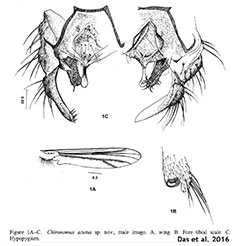 Female: not described. Pupa: Length 5.56-6.92 mm.; wing sheath 1.36-1.44 mm long. Yellowish, exuviae grey. Frontal apotome triangular with subapical frontal setae 30-38 µm long. Cephalic tubercles cone-shaped 86-92 µm long and 64-69 µm wide. Basal ring of thoracic horn bean shaped. 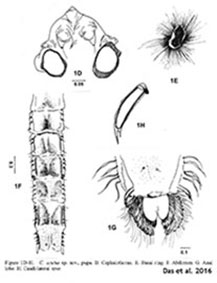 Fourth instar larva: Deep red in color, 5.68-8.60 mm long, VT 880-1120 µm long, anal tubules 560-880 µm long. &nsp;There is no mention of lateral projections or indication of whether the ventral tubules are coiled or straight. 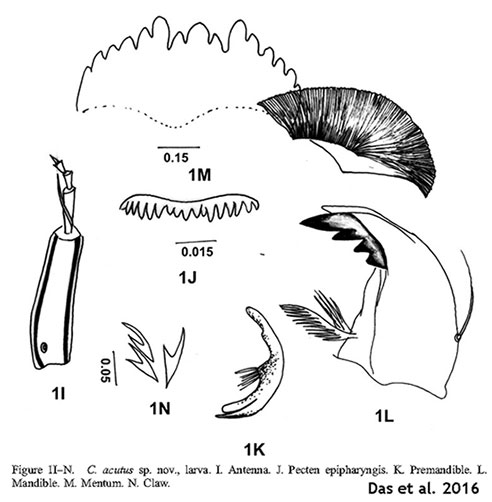 Noted as close to C. incertipenis and C. ramosus in structure, but thoracic chaetotaxy is quite different. Found: India - Type locality Itanagar (27.03°N. 93.63°E, 440 m a.s.l.) Arunachal Pradesh. |
Modified: 1 June 2026
Access: Unrestricted
Copyright © 2022-2026, Jon Martin.