Chironomus brevistylus Guha et al. 1985.Adult: Body length 4.73 mm, wing length 2.1 mm), wing width 0.57 mm. Antenna missing. Head yellow; vertex with 11 setae; 20 clypeal setae, clypeal ratio 1.2. Maxillary palp brown, ratio of segments: 10 : 11 : 40 ; 50 : 64; P5/P4 1.28; P5/P3 1.63. Frontal tubercles well developed. CA 0.68, CP 1.15. Thorax yellow, antepronotum collar-like without v-shaped emargination; postnotum yellow and bare. Setae: 2 Acrostichal; 9 Dorsocentral; 4 Prealar; 10 Scutellar. Wing: 2 Scf on brachiolum, 13 setae in squamal fringe. Dark spot on fCu. CR 0.97, VR 1.05. Femur and tibia of all legs yellow, tarsomeres of fore and hind legs missing from type, TI-III of midleg with apical brown band, rest brown, LR1 2.1; LR2 0.68; LR3 0.64. Ta4 of anterior legs noted as unusually long (from paratypes). Abdomen yellow and terga uniformly setaceous. Anal point slender with apex blunt. Gonocoxite with 16-18 setae; gonostylus short and stout, coming to a narrow point (hence name). Superior volsella closest to E-type of Strenzke (1959); Inferior volsella short and wide, extending barely past the base ot the anal point and the gonostylus, shown with simple setae. HR 1.3; HV 4.27. 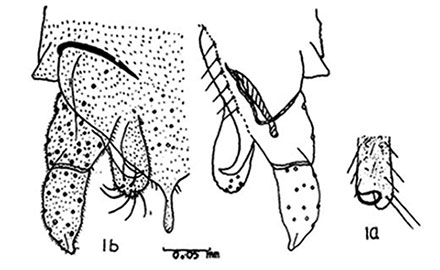 From Guha et al. 1985. Body length 4.07 mm, wing length 2.07 mm, width 0.66 mm. Femur and tibia brown, TI-III with brown apical band, rest of all legs brown. Antenna pale, seg. V longest and brown, ratio of flagellomeres I-V: 9 : 7 : 7 : 8 : 12. AR 0.26; A5/A1 1.33. Genitalia: Notum 0.15 mm. Coxosternapodeme incurved. Gonapophysis VIII divided into a broad posteriorly directed dorsomesal lobe, hooked ventral lobe and needle-like apodeme lobe. Gonocoxite IX with 4 setae on each side. Postgenital plate protruded and pointed at apex. Seminal capsules oval, measuring 0.06 mm x 0.039 mm, ducts bent and open separately. Allotypes: 9, data as holotype, paratypes 2 males, 2 females, collected same locality. |
Modified: 4 June 2026
Access: Unrestricted
Copyright © 2025-2026, Jon Martin.