C. confectus Das, Mazumdar & Hazra 2016.

Adult

Male:
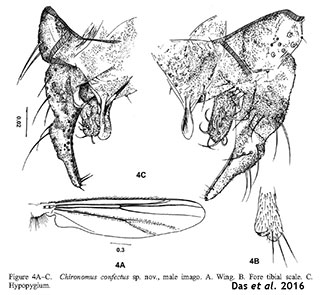
Length 5.52-6.32 mm.  Wing length 2.48-2.76 mm; width 0.71-0.78 mm. AR 2.8-2.9.
Head yellowish brown, antenna brown.  Thorax yellowish brown, antepronotum dark brown. Wing membrane brown with dark veins.  Legs yellow.  Abdomen brown with faint median spots on tergites II-IV.
Frontal tubercles 64-77 µm long and 38-50 µm wide.  Cypeus 1.22-1.34 times the diameter of the antennal pedicel, with 22-24 setae.  Palp segments 153-170 ; 42.5-51 ; 170-187 ; 153-170 ; 255-272.
Thoracic setae: 10-12 acrostichal; 10-12 dorsocentrals; 6-8 prealars; 16-18 biserial scutellar.
Wing with 2 setae on brachiolum, squama with 14-15 setae, VR 0.83-0.84.
Leg lengths (microns) and proportions as follows:
 
Fe
Ti
Ta1
Ta2
Ta3
Ta4
Ta5
LR
BR
PI
1120-1200
960-1000
1520-1560
720-760
640-700
560-600
280-320
1.56-1.58
3.50-3.52
PII
1200-1240
1000-1040
600-640
280-300
200-220
160-180
120-140
0.60-0.62
 
PIII
1280-1320
1240-1320
840-880
400-440
280-320
200-240
200-220
0.66-0.68
 

TIX with 10-12 setae apparently in individual spots (Fig. 4c).  Anal point narrow at base.  Gonostyle relatively swollen basally and narrowing markedly over distal half.  Superior Volsella closest to S-type(d) of Strenzke (1959); Inferior volsella reaching about to end of anal point or basal third of the gonostyle (Fig. 4c).

Pupa: (Males) Length 5.72-6.68 mm, wing sheath 1.15-1.17 mm long.  Yellowish brown, exuviae grey.  Cephalic tubercles (Fig. 4D) 86-92 µm long and 43-53 µm wide at base; antennal sheath 1.04-1.08 mm long.  Thorax rugose.  Respiratory base not measured, but illustrated (4E, below) not constricted and with HR about 1.3.
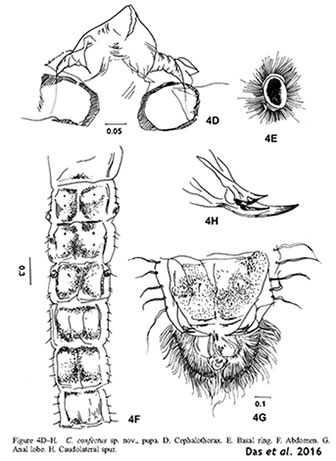
Abdomen yellowish brown, shagreen pattern shown in figure 4F.  Hook row of 44-48 hooklets, separated in mid-line.  Pedes spurii B on segment II (65-70 x 43-48 µm) and segment III, Pedes spurii A on segment IV (73-78 x 65-70 µm).
Caudolateral spur of segment VIII (4H, below) 138µm long with 5 sharp spines, median one strongest.  104-108 taeniae on anal lobe.

Fourth instar larva:Length 7.72-8.60 mm.  No details of head coloration given.
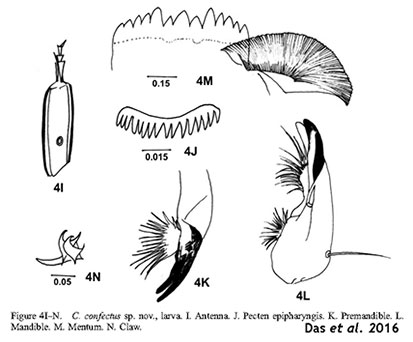
Antenna (Fig. 4I) with basal segment about 3.3 times longer than wide, RO about a third up from the base of the segment.  Length of segments (micron): 77.4-81.7 ; 17.2-21.5 ; 8.6-12.9 ; 10.75-12.9 ; 4.3-6.45.  AR 1.9-2.1.
Mentum (Fig. 4M) with 15 teeth, of type I, center trifid tooth lower than lateral teeth, possibly type IIA.  Ventromentum with serrated margin and slightly wider than the mentum, number of striae not recorded.
Premandible (Fig. 4k) dark brown with teeth narrow and coming to relatively sharp point.
Pecten epipharyngis (Fig. 4J) with 12-16 teeth (Ty. A).
Mandible (Fig. 4L) 190-200 µm long with pale apical tooth, dorsal and inner teeth dark, Pecten mandibularis with about 13 taeniae, no mention of basal furrows.

Found:  Type locality: Bomdila (27.25°N, 92.04°E, 2217m a.s.l.), Arunchal Pradesh..

The authors note various components with similarity to a variety of species, but the apparently S-type SVo of Strenzke (1959) is rare in India and suggests a connection to the C. flaviplumus-group.  However others characters raise a query as to whether this species belongs in Chironomus s.s. or in one of its close relatives.

[ Return to Index| Go to References ]


Modified: 4 April 2025
Access: Unrestricted
Copyright © 2009-2025, Jon Martin.