Chironomus fortibracchius Das, Majumdar and Hazra 2016The name derives from the strong claws of the legs.Adult Total length 4.3-5.8 mm. Wing length 2.38-2.86 mm; width 0.52-0.63 mm, ratio of wing length and length of anterior femur 2.20-2.55. AR 3.16-3.18. Head and antenna dark brown; thorax yellowish brown, wings light yellow; postnotum brown. Head: Frontal tubercles 52-59 µm long and 30-37 µm wide, i.e. 1.59-1.73 times longer than wide; Eyes bare, vertex with 18-22 setae. Clypeus 170-181 µm long and 102-112 µm wide, with 24-26 setae. Ratio of papal segments: 51-68 : 34-51 : 170-187 : 136-153 : 153-170; P5/P4 1.11-1.25; P5/P3 0.90-1.0. Antenna dark brown. Thoracic setae: 8-10 acrostichals; 10-12 biserial dorsocentrals; 4-6 prealars; 14-16 scutellars. Wing: 2 Scf on brachiolum, 16-17 setae in squamal fringe; RM dark distal to FCu; VR 0.90-0.95. Legs pale yellow and abdomen yellowish brown; tergites II-IV with median dark spots. Leg lengths (µm) and proportions:
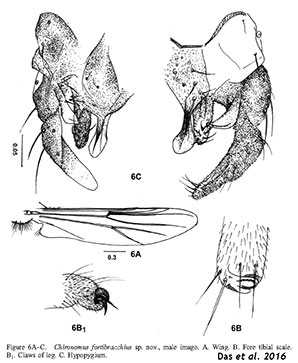 Male hypopygium, wing, fore tibial scale and claw of adult male of C. fortibrachius Das, Majumdar & Hazra, 2016 Hypopygium with anal point narrow at base and widened (spoon-like) at tip. Superior volsella closest to S(a)-type of Strenzke (1959); Inferior volsella, shown with simple setae, reaching almost to the end of the anal point and about 1/3 along the gonostylus, which is quite swollen and narrows relatively gently over distal third, with about 5 setae at tip. Female: Not known. 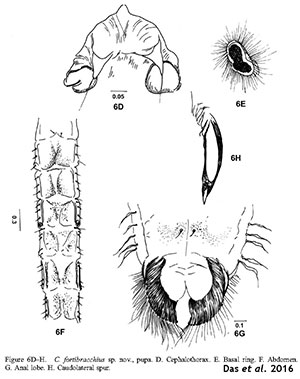 Pupal characters of C. fortibrachiusDas, Majumdar & Hazra, 2016 Abdomen yellowish brown, shagreen pattern shown in figure 6F: tergite I bare, tergites II-IV with median shagreen, V little dark, VI with one small light median and 2 small patches of dark basomedian shagreen. Hook row of 68-74 hooklets, separated in mid-line. PSB on segment II (65-69 x 52-56 µm), PSA on segment IV (69-74 x 60-65 µm). Caudolateral spur of segment VIII (6H, above) 142-147µm long with a sharp spine. 172-178 taeniae on anal lobe. Larval characters of C. fortibrachius Das, Majumdar & Hazra, 2016 Antenna with basal segment about 3.3 times longer than wide, RO about a thrd up from the base of the segment. Length of segments (micron): 107.5-111.8 ; 34.4-38.7 ; 12.9-17.2 ; 8.6-10.75 ; 4.3-6.45. AR 1.78-1.80. RO about a third up from base of segment. PE with 14-16 teeth, perhaps type A. Mentum of ty. 2 with center trifid tooth lower than lateral teeth, possibly type IIA. Premandible with 2 relatively narrow teeth, possibly Ty. 1(?). Mandible 111-115 µm long, of ty. IIIC; no information on Pecten mandibularis or basal striae, MTR about 0.3. Ventral tubules 150-160 µm long, anal tubules 116-125 µm long. Found: Type locality - Kalimpong (27.04°N, 88.28°E 1247 m a.s.l.), West Bengal, India. Shows relationship to C. fortistylus in wing and venation pattern, but it might have some relationship to C. bipunctus which also occurs at high elevations. |
Modified: 30 March 2026
Access: Unrestricted
Copyright © 2005-2026, Jon Martin.