Adult:
Male:
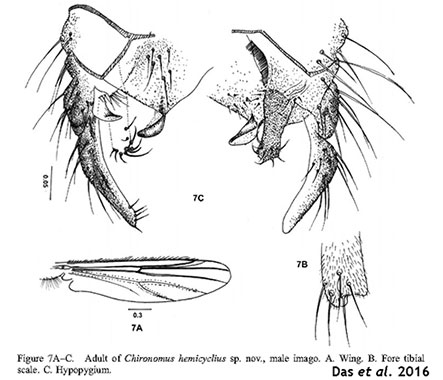
Total length 4-74-4.92 mm. Wing length 2.4-2.7 mm; width 0.48-0.56 mm.
Colour: Head brownish black; palps yellowish brown; thorax yellow, antepronotum brown; postnotum brown. Wing pale, veins brown. Abdomen yellowish brown, TII-IV with median light brown spots; tarsi brown.
Thoracic setae: 12-14 acrostichal, biserial; 14-16 dorsocentrals, biserial; 3-6 prealars; 16-18 scutellars.
Wing: 1 Scf on brachiolum, 11-12 setae on squamal fringe. VR 0.98-0.99.
Leg lengths (micron) and proportions:
|
Fe
|
Ti
|
Ta1
|
Ta2
|
Ta3
|
Ta4
|
Ta5
|
LR
|
BR
|
PI
|
1080-1120
|
840-880
|
1520-1560
|
800-840
|
720-760
|
600-620
|
280-300
|
1.77-1.81
|
1.60-1.62
|
PII
|
1120-1160
|
960-1000
|
600-620
|
360-380
|
240-280
|
160-180
|
80-100
|
0.62-0.63
|
5.10-5.12
|
PIII
|
1200-1240
|
1200-1240
|
880-900
|
480-500
|
320-340
|
200-220
|
120-140
|
0.72-0.73
|
4.00-4.10
|
Female: Not identified.
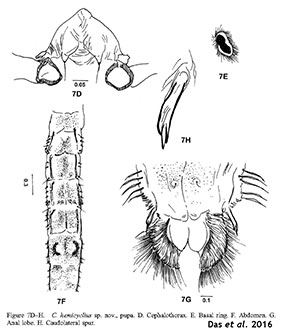
Pupa: (Males) Yellowish brown in colour, exuvia grey. Length 7.04-7.92 mm. Frontal apotome (Fig. 7D) triangular with subapical frontal setae 52-56 µm long. Funnel shaped CT 64-72 µm long and 30-34 µm wide at base, with 1 seta. Antennal sheath 765-795 µm long; wing sheath 1.40-1.48 mm long. Thoracic horn plumose, with elliptical ring at base (Fig. 7E), HR perhaps 1.9.
Tergite I bare, II-V with median shagreen, VI with two semicircular median basolateral shagreen, VII with subbasal and subcaudal light patches of shagreen, VIII with very faint mediolateral shagreen; segment II with basolateral PSB, segment IV with caudolateral PSA (62-69 x 50-56) µm.
Hook row with 72-76 hooklets, stated to be divided but figure only shows it could be compressed anteriorly in midline as commonly occurs during mounting.
Caudolateral spur of segment VIII (Fig. 7H) long, with 3 appressed spines. Anal lobe (Fig. 7G) with 144-150 setae in rows.
Fourth instar larva:
Length 8.3-8.9 mm. Deep red in colour. Larval type not clear - there is no mention of lateral projections, but while the length of the ventral tubules is given (150-162 µm), it is not indicated whether they are straight or if posterior pair are coiled. Anal tubules 116-125 µm long.
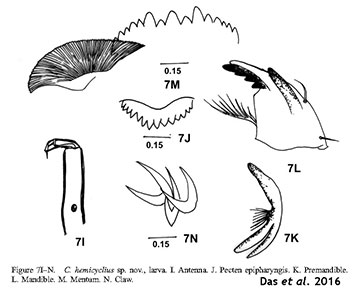
Antenna (Fig. 71, above) with long narrow basal segment, RO about a third up from base.
Antennal proportions 52-55; 21.5-26 : 8.5-13 : 13-17 : 6.5-8.5. AR 1.04-1.06.
Pecten epipharyngis (Fig. 7J, above) with 8-10 teeth (type B?). Premandible with 2 teeth, inner shown as only slightly wider than outer and coming to a relatively blunt point (possibly type B2).
Mentum 107-some 115 µm wide, possibly Ty I, but 4th lateral may be slightly reduced; central trifid tooth possibly Ty IIA. Width of Ventromentum unclear as claimed to be only about 1/3 of the width of the mentum but illustration shows them to be about the same width, so possibly this is the interplate distance; anterior margin serrated.
Mandible 116-135 µm long, of type IIIC; Pecten mandibularis with 12-14 taeniae.
Found: INDIA - Type locality - Kalimpong (27.04°N, 88.28°E 1247 m a.s.l.), West Bengal
Noted as similar to C. circumdatus in some characteristics. However, the critical characters for identification are not provided.
[ Return to Index | Go to References ]