Einfeldia kanazawai Yamamoto, 1996Adult: AR 2.81 (2.61-3.06). Head, including antennal pedicel and mouthparts, dark brown. Antepronotum, postnotum and scutellum yellowish white (ground color), vittae brown, postnotum dark brown. Legs yellowish white, tarsi somewhat infuscated, front tarsi broken. Wings hyaline, crossvein slightly darkened. Haltere yellowish white. Abdomen including geitalia uniformly dark brown.Brownish black, with thorax largely blackish brown, vittae etc. brownish black; legs brown to dark brown. Abdomen uniformly brownish black. Head: Frontal tubercles linear, 20µm long, 10 µm wide. Palp segment lengths (1-5) (micron): 60 : 40 : 170 : 180 ; 270; P5/P4 1.5, P5/P3 1.6. 15 clypeal setae, 27 setae on vertex. Thorax with a prominent median tubercle; Setae: 16 achrostichals (biserial); 12 dorsolaterals; 5 prealars; 1 supraalar; 17 scutellars (biserial). Leg length (means) and proportions (micron)
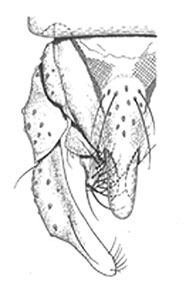 Hypopygium of E. kanazawai from Yamamoto (1996) Anal point broad, narrowing slightly at distal end. Superior volsella closest to S-type of Strenzke (1959). Inferior volsella expanded at tip, with some bifid setae, not reaching the end of the anal point, but to about a third of gonostylus. Gonostylus moderately swollen and narrows markedly at about half to two thirds of its length, 1+5 setae at tip. Female: Head: Antenna (µm): 163 : 110 : 119: 110 : 219; AR-0.44, A5/A1 1.34. 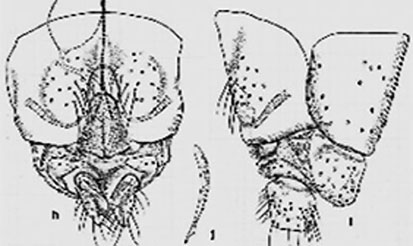 Female genitalia of E. kanazawai from Yamamoto et al. (2015) Pupa, Larva and Cytology not known. A characteristic of this species is the very long anterior Ta4 of both sexes. Found: JAPAN. Type locality - Kampira, Iriomotejima Is., Ryukyus.; |
Revised: 4 June 2026
Access: Unrestricted
Copyright © 2018-2026, Jon Martin.