Chironomus lurilatus Das, Majumdar & Hazra, 2016Adult:
Male: Wing length 2.44-2.64 mm; width 0.68-0.76 mm. AR 2.59-2.81. Ratio of wing length and length of anterior femur 2.26-2.28.
Head brownish-yellow, antenna brown; eyes bare; vertex with 22-26 setae.
Frontal tubercles 71-81 x 39-45 µm, 1.8 times longer than wide.
Clypeus with 19-20 long setae; palp segments (1-5) 42.5-51 ; 51-68 ; 187-204 ; 153-161.5 ; 136-153; P5/P4 0.89-0.94; P5/P3 0.73-0.75.
Thorax yellow with light brown antepronotum and dark postnotum.
Setae: Acrostichals 12-13 in two irregular rows; dorsocentrals 15-16; prealar 9-10; scutellars 12-14, no information as to whether scattered or in rows.
Wing pale with brown veins, 2 Scf on brachiolum. 12-13 setae on squama.
Legs brownish yellow.
Lenghts (µm) and proportions:
| Fe
| Ti
| Ta1
| Ta2
| Ta3
| Ta4
| Ta5
| LR
| BR
| PI
| 1120-1160
| 1000-1040
| 1560-1600
| 800-820
| 720-800
| 560-600
| 280-300
| 1.54-1.56
| 1.50-1.54
| PII
| 1200-1240
| 1240-1280
| 880-820
| 440-500
| 320-360
| 200-240
| 120-160
| 0.71-0.72
|
| PIII
| 1320-1360
| 1160-1200
| 840-880
| 440-480
| 360-400
| 240-280
| 120-140
| 0.72-0.73
|
| Abdomen pale yellow, tergites II-IV with faint grey median spots.
TIX with 9-11 setae, possibly with 1 or 2 in a single paler areas.
Anal point narrow at base and a bulb-like apex. Superior Volsella closest to D(e) type of Strenzke (1959). Inferior Volsella reaching beyond the end of the anal point and almost to the beginning of the narrowing of the gonostylus, which is swollen and narrows markedly over about posterior third, with 4+1 setae at tip. 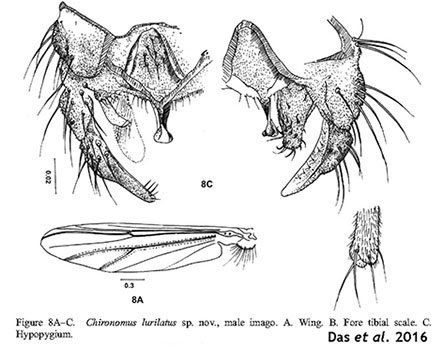
From Das, Majumdar & Hazra, 2016Female: Not described.Pupa: Total length 6.48-6.62 mm. Frontal apotome (Fig. 8D) triangular with 2 subapical frontal setae. Cephalic tubercles cone shaped, 60-68 µm long and 21-24 µm wide at base. Thorax rugose.
Wing sheath 1.36-1.44 mm long. HR about 2.4 (Fig. 8E).Abdomen (Fig. 8F) yellowish brown, TI bare, II-VI with median shagreen, VII bare, VIII scattered shagreen. Caudo-lateral PSB on TII, PSA (60-69 x 76-81 µm) on TIV. Conjunctives III/IV and IV/V with a pair of short L-setae. Hook row, separated consisting of 46-48 hooklets. Caudolateral spur (Fig.8H) with a trifid pointed apex.
Anal lobe (Fig. 8G) with a fringe of 146-150 taeniae. 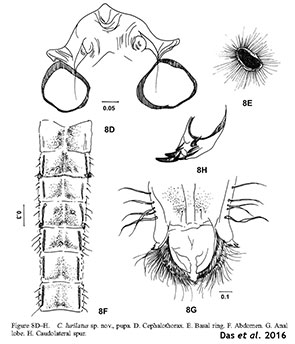
From Das, Majumdar & Hazra, 2016Fourth instar larva: Total length 7.80-8.86 mm. Vemtral tubules 1.28-1.48 mm, but not clarified that there are 2 pairs. Anal tubules 0.96-1.20 mm. No details of head coloration.
Pecten epipharyngis (Fig. 8J) with 12-16 teeth. Mentum, 142-148 µm wide, illustrated as Ty. 1, central trifid tooth lowered and Ty. 4 (Fig.8M), as in C. vitellinus. Ventromental plates 47-51 µm wide, with serrated margin, ICD 95-100 µm.
Premandible (Fig 8K) with 5 teeth, ouyter tooth shown as shorter than the other teeth.
Antenna (Fig 8I) with RO about one third up from base. Segement lengths 107.7-111.8 ; 25.8-30.1 ; 12.9-17.2 ; 8.6-12.9 ; 4.3-6.45; AR 1.69-2.08; blade not extended beyond flagellum.
Mandible 176-186 µm long, 1 pale dorsal, 1 dark apical and 3 distinct dark inner teeth. Pecten mandibularis prominent, but not counted. 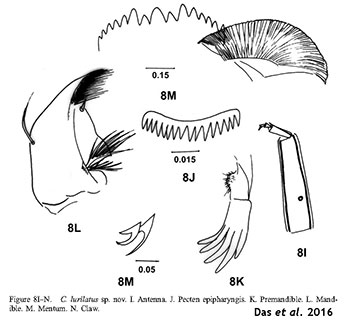
From Das, Majumdar & Hazra, 2016Found: India - Type locality Pasighat (28.12°N. 95.55°E, 153 m a.s.l.) Arunachal Pradesh. The relationships of this species are not clear, but it might have some relationship to C. bipunctus which also occurs at high elevations. Some characters suggest that it might not be Chironomus (s.s.), although others suggest it may be related to C. vitellinus. [ Return to Index | Go to References ] |