Chironomus riparius Meigen, 1804Incorrect synonym - Chironomus lugubris Tokunaga 1938 (Sasa & Yamamoto 1977) In BOLD Bin: BOLD:AAA7263. C. riparius is a member of a species group and currently can only be accurately identified from the BOLD barcode sequence or the larval polytene chromosome banding patterns. Adult (based on U.S. material): Male: Ground color pale to dark brown, thoracic markings red-brown to blackish brown; legs pale green to light brown towards their bases, tarsal segments darker; abdomen brown to blackish, apical 0.25 of each tergite pruinose and pale. Specimens from colder habitats are darker. Head: Frontal tubercles small 10-30 x 15 µm (l/w 1.5-2), clypeus rather small (0.66-0.72 of diameter of antennal pedicel) with 34-39 setae. Palpal proportions (micron): 69 : 69 : 129 : 130 : 191 (P5/P4 - 1.47; P5/P3 - 1.48). Some thoracic setae: Dorsocentral - 27-33; Prealar - 6-7; Supraalar - 1-2; Scutellar - about 24 setae; 9 in 2 rough anterior rows and 15 larger setae in posterior row. Leg lengths (micron) and proportions (1 specimen):
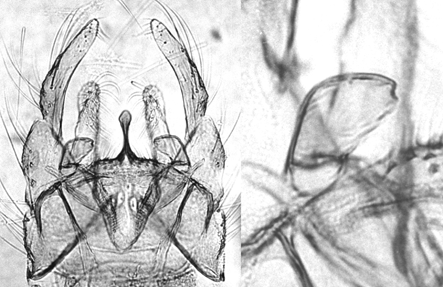 Terminalia of adult male The Superior Volsella is Strenzke's S(b) type; Inferior volsella long, reaching to about middle of gonostyle, with simple setae. Gonostyle only moderately swollen and narrows gently from about midpoint or more rapidly over posterior 2/3. Anal point narrow at base and widening at distal end. Female: According to Townes (1945), similar to male except for usual sexual differences. About 13 setae on the crescent shaped segment X, which is about 3.3 times longer than the greatest width. Morisch & Wülker (1987) Fig. 1 shows the cercus to have a relatively pointed posterior end, with a significant ventral bulge.  From Morisch & Wülker 1987  C. riparius (N.A.) mouthparts Found: INDIA - unconfirmed record from Kasar Lake, Dharur (18.92°N, 76.20°E), Bindusara River, Beed (18.90°N, 75.73°E), Many of these records are unconfirmed and may actually refer to related species. As well, the cytology and COI sequence has not been reported to help confirm identity. Only the Kiknadze et al. 2016 identification can be considered reliable. If it does occur, it seems to be relatively rare. |
Revised: 13 August 2026
Access: Unrestricted
Copyright © 2024-2026, Jon Martin.