|
Chironomus tusimaabeus Sasa & Suzuki 1999
Adult 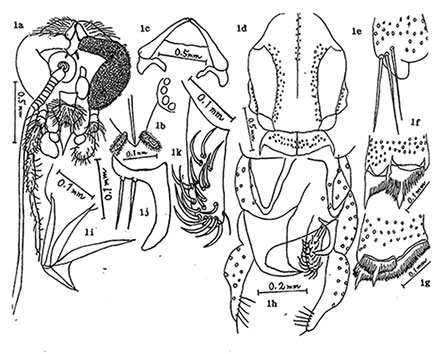 Hypopygium and superior volsella of C. tusimaabeus from Sasa & Suzuki 1999 Body uniformly black or dark brown, abdominal tergites slightly paler along caudal margin. Setae on scutellum and abdomen arising from pale pits. Head: Antenna with 11 flagellar segments, AR 3.96 (3.80-4.11). Frontal tubercles prominent 54 µm long and about 3.5 times longer than wide. Palp 5 segmented, segment I with a seta, other segments with numerous setae; 45 (34-56) clypeal setae. Thoracic setae: 20.7 (16-26) acrostichal; 34.8 (34-36) dorsocentral; 7.3 (7-8) prealar; 39 (37-41) scutellar in two rows. LR1 1.48 (1.43-1.54); LR2 0.59 (0.58-0.62); LR3 0.74 (0.70-0.80); BR 3.8 (3.2-4.4), i.e. short beard. No indication of setae on TIX. Hypopygium with anal point extremely and unusually wide and sickle-shaped in lateral view; Superior vosella possibly E-type (h) of Strenzke (1959); Inferior Volsella reaching about to tip of anal point and a third along the gonostylus, with 18 simple recurved setae. Gonostylus moderately swollen and sharply constricted over distal third and with 6 setae at distal end. Female, pupa, larva and cytology unknown. Found: JAPAN Type locality - Kechi Dam, Mitsushima, and Nita Dam, Kamiagata, both Tsushima Island, Nagasaki Prefecture, Kyushu. [Holotype: male, 355:018 (NSMT-I-Dip 5166); paratypes: males, No. 355:95, 374:57]. |
Modified: 11 April 2026
Access: Unrestricted
Copyright © 2020-2026, Jon Martin.