|
Chironomus strenzkei Fittkau 1968 (was C. striatipennis type 2 of Pramual et al. 2016) Under incorrect names Adult: The abdomen of C. strenzkei (see below) is similar to that of C. striatipennis and C. kiiensis. The laboratory reared specimens from the Plön colony are larger than those collected in the wild. Wing length about 2.27 (1.56-2.64) mm, width 0.64 (0.55-0.73) mm. VR = 1.08 (1.04-1.14). AR about 2.49 (2.10-2.95). Frontal tubercles developed, about 62 (35-68) µm long and 18.3 (15-22) µm wide. 17-18 setae on clypeus; palpal proportions (µm) 52 : 38 : 139 : 154 : 243; P5/P4 1.53-1.63; P5/P3 1.58-1.96. Thoracic seta: acrostichal - 10-13; dorsocentral - 16-18; prealar – 4-5; supraalar 1; scutellar in two rows, anterior - 4-7, posterior - 9-11 (total 14-16). Wings with dark spot over the crossvein and with obvious dark clouds and seams, particularly in cell R5, as in C. striatipennis; abt 6-14 SCf on brachiolum in two clusters, abt 18 setae in squamal fringe. Leg lengths (micron)and proportions:
Superior volsella of the E(h)-type of Strenzke (1959). Anal point narrow at base and expanded at tip. Inferior volsellao reaching about to end of anal point. Gonostylus moderately swollen and reducing markedly over distal half.  Male hypopygium (above) and details of the Inferior volsella and anal point (below) Female not described. Pupa: Length 5.5-7.5 (Fittkau 1968). A single male pupal exuvia from the Plön culture was available for more detailed analysis. 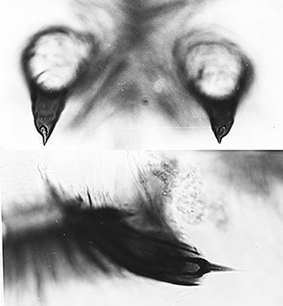 Pupal cephalic tubercles (above) and spur (below) of C. strenzkei Fourth instar larva: a small plumosus-type of length 9.2-10.8 mm (fem. abt. 9.2 mm; male 9.5-10.8). Anterior ventral tubules bent and posterior ventral tubules coiled with posterior longer (ant 0.74 mm, post 0.78.mm). Lateral tubules 220 µm; anal tubules rel. long: dorsal 350 x 120 µm (l/w 2.9); ventral 380 x120 µm (l/w 3.2). Cytology: Four polytene chromosomes with the pseudothummi-cytocomplex combination BF, CD, AE, G (Wülker & Morath 1989). While obviously close to C. striatipennis, there are some significant differences. 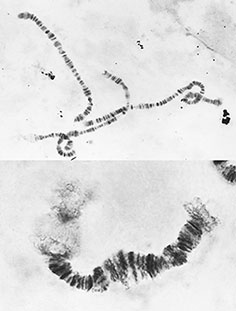 Whole complement (above) and arm G (below) of C. strenzkei Found: BRAZIL - Manaus, Amazonas (Type locality) Adult and immatures described by Al-Shami et al. (2012) as C. kiiensis may refer to this species. Molecular: The mitochondrial COI differs from that of both C. striatipennis and the sequence of the common form of C. kiiensis, as well as the recently identified taxa C. nr. kiiensis and C. kiiensis kMYTH. The sequence is found in Japan and SE Asia, but has not been found in India. The sequence of C. strenzkei is identical to that of this species, and since this taxon has no formal name, it becomes C. strenzkei (i.e. that species is not a synonym of any other member of this group). |
Revised: 23 October 2025
Access: Unrestricted
Copyright © 2016-2025, Jon Martin.