Species 3w. C. vockerothi Rasmussen.

Was placed in the subgenus Camptochironomus.
It has been suggested that this is a hybrid between C. dilutus and another species.

Adult:
Description largely based on that of Rasmaussen, 1984.

Male:
A mostly dark species, with the hypopygium somewhat darker.


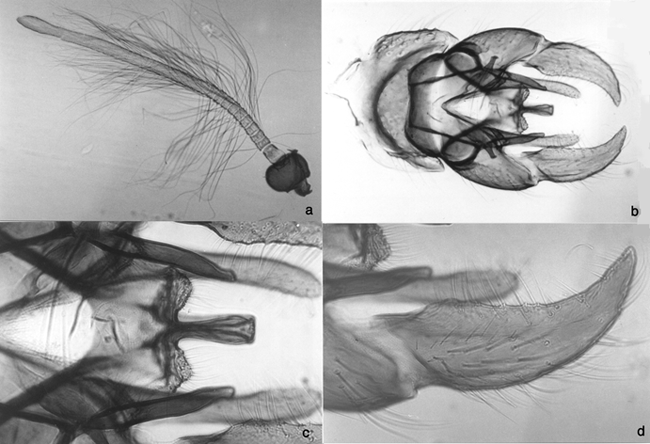
Paratype male of C. vockerothi
a. antenna; b. hypopygium; c. Superior volsella (note the length); d. gonostylus.

Wing length 3.1-3.8 mm, wing width abt. 0.96 mm, VR 0.95-1.0; 19-25 setae in squamal fringe.  AR 1.89-2.35.  Fore LR 0.95-1.09.
Head: Frontal tubercles present, length about 250 µm.  Palpal proportions (segs 2-5)(µm): 68 : 188 : 182 : 245; P5/P4 1.35. P5/P3 1.30.  Clypeus with 21-38 setae.
Thorax: Mesonotal tubercle well developed.  Setae: Acrostichal 8-18; Dorsocentral 25-54, uni- to tri-serial; Prealars 7-14, uni- to bi-serial; Scutellars 29-46, uniserial laterally to multiserial medially, about 14-16 in most posterior row.
Legs (micron):

 
Fe
Ti
Ta1
Ta2
Ta3
Ta4
Ta5
LR
F/T
BR
PI
1610
1310
1450
820
620
440
260
0.95-1.09
1.14
1.05-1.24
PII
1530
1550
690
470
370
270
200
0.44-0.45
0.99
 
PIII
1680
1760
940
580
510
310
210
0.53
0.95-0.96
 

Male terminalia enlarged, suggesting the species mates on the substrate.  Gonostyles strongly curved and narrowing evenly, similar to that of C. dilutus; anal point broad with a squared off end; with two setose lobes flanking it.  Superior volsella large, darkly pigmented, curved ventrally towards the apex, and lacking setae.  Inferior volsella long and narrow, reaching about half way along the gonostyle.

Female:

Coloration, wing length, squamal setation, and thoracic characters stated to be similar to those of the male.
Additional information from paratype 18183:
Wing length abt. 3.50 mm, width abt 0.94 mm., VR 1.00-1.01.  SCf on brachiolum - abt 4.
Antennal proportions (micron): 105 : 80 : 98 : 113 : 185.  AR about 0.47, A5/A1 about 1.76.
Palp proportions (segs. 2-5) (micron): 80 : 180 : 173 : >245 (shrivelled).  37 clypeal setae
Thoracis setae: abt. 12 acrostichals; 19-23 dorsocentrals (including humerals?); 6 prealar; scutellars in 2 approximate rows 24 in anterior, 12 in posterior row (total 36).

Leg proportions of 1 specimen (micron):

 
Fe
Ti
Ta1
Ta2
Ta3
Ta4
Ta5
LR
F/T
Ta4/Ti
PI
1080
1120
1080
620
500
360
180
0.96-1.25
0.96
0.32
PII
1300
1260
620
380
300
200
180
0.42-0.49
1.03
 
PIII
1420
1420
900
540
460
260
180
0.57-0.65
1.00
 

Genitalia: Dorsomesal lobe of GpVIII somewhat reduced, with inner margin distinctly sclerotized.  GcIX small with 1-2 setae.  Segment X large and produced into posterolateral lobes, each bearing 22-35 setae.  Ventrolateral lobe short, apodemal lobe small and indistinct on most specimens.

Pupa, Larva and Cytology not known

Found: Alberta - Elkwater (49.65°N, -110.28°W) and Hastings Lake.(Type localities)

Adult alone described by Rasmussen (1984).
Distinguished from C. dilutus and C. pallidivittatus by the smaller size and well developed mesonotal tubercle.  The males can be distinguished by the long superior volsella;  females by the long extended gonopophysis X.

[ Return to Index| Go to References ]


Modified: 1 September 2026
Access: Unrestricted
Copyright © 2000-2026, Jon Martin.