Species 6a Chironomus aversa Roback 1962.Original desription of Roback: This species is close to both C. attenuatus (Wlk.) [=decorus Joh.] and T. riparius (Meig.), combining some of the characters of both. It can be separated from the former by the narrow anal point and from the latter by the horn-shaped, pointed superior apendage. In the presence of dark spots on veins Cu2 and the abdominal maculation it resembles T. attenuatus. Male: length 5.4 mm. (variation 4.8-5.1): head brown; antennal ratio 3.3: frontal tubercles 0.05 mm long by 0.02 mm wide at base; palpal segments (segs. 2-5 only) in ratio 10 : 35 : 43 : 64 (P5/P4 1.49; P5/P3 1.83); pronotum light; darkened lateroventrally; mesonotum light, three distinct red-brown vittae; pleura light; pteropleuron (= anepisternum) with brown spot; sternum red-brown; scutellum light; postnotum black-brown; wing 3.0 mm (variation 2.4-3.0); r-m and fCu darkened; squamae fringed; leg ratio 1.9; apex of forefemur, basal third of foretibia and apices of tibiae and tarsal segments 1-4 darkened, meso- and metathoracic legs like forelegs except only small basal area of tibia darkened; tarsus 5 dark; no hair fringe (i.e. beard) on foretarsus; abdomen light with greenish cast; abdominal tergites 2-6 with a mesal longitudinal brown mark (two third length of segment); some brown infuscation on either side of this; tergites 7-8 more completely brown infuscated (but variation between specimens); sternites 1-5 light. 6-8 darker, aedeagus light brown (Fig. 21); inferior and superior appendages (Figs 24, 25). 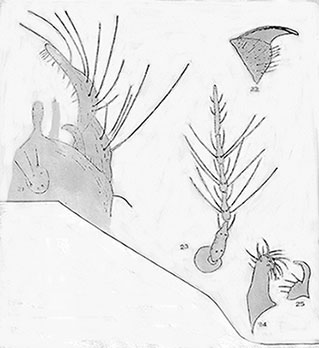 Male hypopygium and female antenna of C. aversa from Roback 1962
Type in collection of Academy of Natural Sciences of Philadelphia, Type No. 6835 Note: Occurrence at a U.S. Air Force base means there is an increased possibility that it could be transported to the U.S.A. |
Modified: 5 July 2026
Access: Unrestricted
Copyright © 2020-2026, Jon Martin.