Hashimoto (1982) redescribed the species based on specimens from Oze, Japan:
Male:
Body length 6.5 mm, width, 0.82 mm. Head with frontal tubules rather small. Antenna with 12 segments (i.e. including the pedicel).
Palps 4-segmented (i.e. segment 1 not identified) relative lengths: 8 : 22 : 28 : 28; P5/P4 1.0 (unusual) & P5/P3 1.27.
Thoracic vittae blackish brown, scutellum & postnotum brown.
Wings hyaline and bare, fCu just at or slightly distad of base of r-m; squama fringed.
Legs yellow to pale brown, apex of each segment more or less dark in colour; anterior tarsi not distinctly bearded.LR 1.4-1.5.; pulvilli well developed.
Abdomen brown, caudal margin of each tergite pale yellow.
TIX shown with about 12 setae, possibly in individual clear areas.
Hypopygium with anal point long and broadened distally. Superior volsella broad apically and sharply pointed at inner apex (closest to D(9) type of Strenzke (1969)).
Inferior Volsella slightly upcurved and broadened apically in lateral view, shown with simple setae.
Gonostylus reaching about to end of anal point, moderately swollen and reducing gently over posterior third.
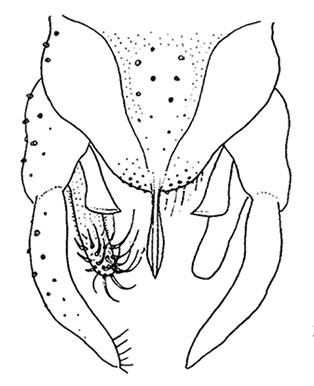 Male hypopygium of C. trinitrivittatus (from Hashimoto 1982)
Female: Hashimoto (1982) obviously collected specimens of the female, but notes only that the antenna is of 6 segments (i.e. including the pedicel).
Hashimoto classes the species as closest to C. samoensis - but if he is referring to the Japanese C. samoensis this would mean C. flaviplumus - and it is quite similar in the characters of the hypopygium to C. flaviplumus Ty. B.
Also noted as similar to C. riparius, but the abdomen of that species is banded.
Sasa has queried whether the differences from C. riparius are just intraspecific variation arising from the different habitats from which the specimens have been collected - C. trinigrivitattus from higher altitudes, while C. riparius is from lowland areas.
Also claimed to have similarities to C. sollicitus but differs in the shape of the anal point and the shape of the Superior volsella and gonostylus.
Found: JAPAN (Russian Japan - Sikuka, Sakhalin (type locality)
JAPAN proper - Ozegahara Moor, Central Japan. (specimens in Dept. Biology, Faculty of Education, Shizuoka University).
[ Return to Index
| Go to C. flaviplumus Ty.B | Go to C. riparius ]