Species 4b. C. strenzkei Fittkau 1968. In Bold Bin: BOLDABZ2474 Originally considered a synonym of C. striatipennis and then of C. kiiensis. Analysis of the Barcode sequence of the additional data now available has indicated that C. strenzkei is actually not a synonym of either of these species, but is identical to an undescribed species (C. striatipennis Ty. 2 of Pramual et al., 2016) occurring in Thailand, Singapore and Japan (the latter probably the site from which specimens travelled to the Amazon and California). Since this taxon has no valid binomial name, C. strenzkei is resurrected as the valid name. Adult: Material from California was described by Sublette and Mulla (2000). Information below is for the California material, but supplemented by data from other populations of this widely distributed species. Variability may be increased by mixture of laboratory-reared and wild-collected specimens.  Male terminalia (left), superior volsella (right) and wing (below) of C. strenzkei Male: Head - Frontal tubules long, about 65 x 18 µm (3.7x longer than wide); about 16 clypeal setae; palp proportions (µm) 60 : 35 : 145 : 160 : 225; P5/P4 1.41; P5/P3 1.55. Wing length 2.74 (1.56-2.64) mm; width 0.64 (0.55-0.73); VR about 1.08 (1.04-1.14); AR 2.49 (2.1-2.95). Thoracic setae: Acrostichal abt 10-13; Dorsocentral 16-18; Prealar 4-5; Scutellar 4-7 in anterior row, 9-11 in posterior row (total 14-16). Abdomenal setae: TIX 7-10 in individual patches; SVo 12-15; IVo 22-24, simple. Wings (see above) with a pattern of dark markings similar to a number of other species of Asian origin. Leg lengths and ratios (µm):
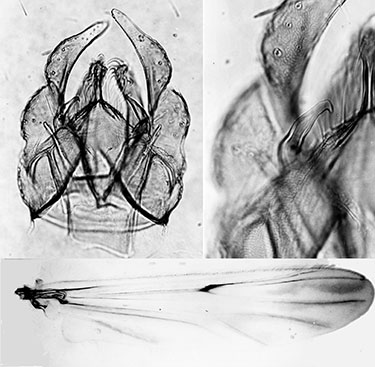
| Fe | Ti | Ta1 | Ta2 | Ta3 | Ta4 | Ta5 | LR | F/T | BR | PI | 1043 | 930 | 1540 | 790 | 615 | 470 | 265 | 1.64-1.78 | 1.10-1.21 | 2.3-3.5 | PII | 1101 | 1037 | 701 | 370 | 268 | 178 | 138 | 0.60-0.82 | 1.01-1.10 | | PIII | 1227 | 1270 | 970 | 595 | 428 | 255 | 170 | 0.72-0.78 | 0.93-1.10 | | Abdominal setae: TIX 7-10 in individual patches; Superior Volsella 12-15; Inferior Volsella 22-24, simple. Anal point narrow; Superior volsella closest to type E(h) of Strenzke (1959). Inferior volsella bending towards the centerline and reaching about to the end of the anal point. Gonostyle narrowing fairly sharply about 1/3 from distal end. Pupa: (based on specimens from other populations)
 Length 5.5-9.8 mm. Exuvia dark brown, shagreen darker on posterior of tergites IV-VI. Cephalic tubercles about 80 µm long and 65 µm in diameter at the base. Prealar tubercle present, not simple, but small, about 25 µm long and 6 µm wide. Basal ring of respiratory horn with edge thicker at the anterior end, and pinched at the centre, about 119-126 µmm long and 60-63 µm wide (HR 1.98-2.0). There are about 3 rough short spines immediately anterior to the basal ring, and a large, possibly muscle scar just posterior to it. Abdomen: About 62-72 recurved hooks on posterior margin of segment II, the hook row covering about 55% of the width of the segment. Pedes spurii B laterally on segment II; pedes spurii A on segment IV about 131 x 89 µm; abt. 0.24 of segment length, while those of segment V and VI are small and mainly identifiable by the spinules. Caudolateral spur of segment VIII with usually 1 main spine, but also one or two small lateral spines. Anal lobe with about 53-72 taeniae on each side, mostly in a single row. Fourth instar larva: (based mainly on Asian and South American specimens) a small plumosus-type, length about 9.3-11.3 mm. Lateral tubules about 280-360 µm, ventral tubules long, coiled, posterior pair usually longer (Ant. 1.40-1.68; post. 1.44-1.84 mm). Anal tubules relatively short (160 x 60 µm), about 2.5 times longer than wide. Head capsule with pale to slightly dark gula, frontoclypeus pale to slightly dark. Teeth of mentum (Fig. c) with flanges, c2 teeth of the central trifid group moderately well separated (type IB or III), 4th laterals slightly reduced (type I+). Ventromentum (Fig. d) with about 34-35 striae, VMR about 0.32-0.36. Pecten epipharyngis (Fig. a) with about 11-13 even sharp teeth. Antenna (Fig. b) with basal segment about 3-3.1 times longer than wide, RO about middle of the segment, AR about 1.62- 1.77; relative lengths of segments 92 : 28 : 8 : 12 : 8. Premandible with relatively narrow sharp teeth, inner tooth about 1.8x width of outer tooth and with an obvious narrow outer edge. Mandible (Fig. e) also with flared teeth and with a characteristic, relatively long, sharp dorsal tooth; 3rd inner tooth partially separated and colored (type IIB); about 13-14 furrows near base, pecten mandibularis with about 8-13 filaments; MTR about 0.34. Cytology: 4 polytene chromosomes with the pseudothummi arm combination: AE, BF, CD, G (Wülker & Morath 1989). Arm G closely paired with a subterminal nucleolus which may have a very close Balbiani ring. No nucleoli in the long chromosomes. In Asia, the species is highly polymorphic. stzA1: 1 - 2c, 11 - 7, 4 - 6, 2d - 3, 12 - 19 as striatipennis A1 stzB: Bulb of group 7 not obvious. stzC: no sequence available. stzD: no sequence available. stzE1: 1a -- 13g i.e. Standard stzF1: 1 - 2a, 15e - 11f, 2b - 15f-a, 11a-e, 16 - 23 as striatipennis F1 stzG1: subterminal nucleolus, with BR nearby; no other BRs visible in available specimens.
Karyotype shows close relationship to that of C. striatipennis.Found:-U.S.A. - California - El Segundo, Los Angeles Co. (Sublette & Mulla 2000) Type locality: BRAZIL - Manaus; Belém. (Fittkau 1968). PERU - Pucallpa (Fittkau 1968). also JAPAN, SINGAPORE, THAILAND and MALAYSIA. Shallow pools with high nutrient content (e.g. algae-rich puddles in the bottom of dugout canoes). Larval habitat in California was not determined, but adults were collected in the vicinity of a wastewater treatment plant.Molecular: The mitochondrial COI differs from that of both C. striatipennis and the sequence of the common form of C. kiiensis, as well as the recently identified taxa C. nr. kiiensis and C. kiiensis kMYTH. The sequence is found in Japan and SE Asia, but has not been found in India. The sequence of C. strenzkei is identical to that of this species, and since this taxon has no formal name, it becomes C. strenzkei (i.e. that species is not a synonym of any other member of this group). GenBank accession numbers: KJ424334-KJ424336. BOLD accession numbers: COTW009, COTW010, COTW013 The COI sequence differs from that of C. striatipennis at 7 bases, from C. kiiensis at 11 bases, from C. kiiensis form kMYTH at 11 bases, and from C. nr.kiiensis at 31 bases.Sublette & Mulla (2000) have identified the species in southern California, suggesting it was a recent hitchhiker from South America as it had not been found in earlier surveys - since it is not native to South America, it is just as likely that it is a separate introduction from the region of Japan (Amora et al. 2015). Sublette and Mulla also state that the cytology had been studied by Wülker and Morath (1989), but that paper only notes that it has the pseudothummi-complex arm combination and the banding pattern is not related to other South American species they studied.[ Return to Index| Go to References ] |